Pricing lawn care in 2026: visit-based billing that survives the weather
Ask five lawn care owners how they price a season and you’ll get five different answers — per visit, a flat monthly average, a seasonal package paid up front. None of them is wrong. What’s wrong is picking a structure that can’t survive a rained-out Tuesday, because in this business, weather isn’t an edge case. It’s the job.
Three ways to price the season
Per visit charges exactly what happened — mow, edge, blow, done, billed. It’s the most honest structure and the easiest to explain to a new customer, but it means an invoice (or a line on one) for every single stop, which adds up fast across a full route.
A flat monthly average smooths a 4-visit month and a 3-visit month into the same bill, so the customer sees one predictable number all season. It’s simpler for them and for you, but only if the averaging is honest — a customer who does the arithmetic and finds they paid for a mow that never happened stops trusting the number.
A seasonal package — spring cleanup through fall cleanup, one price — front-loads the cash and locks in the relationship for the year. It suits a treatment program or a full-service contract better than a bare mowing route, where the customer usually wants to see what they’re paying for, visit by visit.
None of these is universally correct. What they share is the requirement underneath: whichever structure you pick has to bill what actually happened, not what was scheduled to happen.
Why billing the calendar breaks
A weekly schedule assumes fifty-two mows a year. Rain, frost, and a customer’s own cancellation guarantee it never works out that way. If your invoicing runs off the calendar — an invoice fires every Monday whether the crew showed up or not — you’re either billing for work that didn’t happen or manually pulling invoices for every skipped visit. Both cost you something: the first costs trust, the second costs your evening.
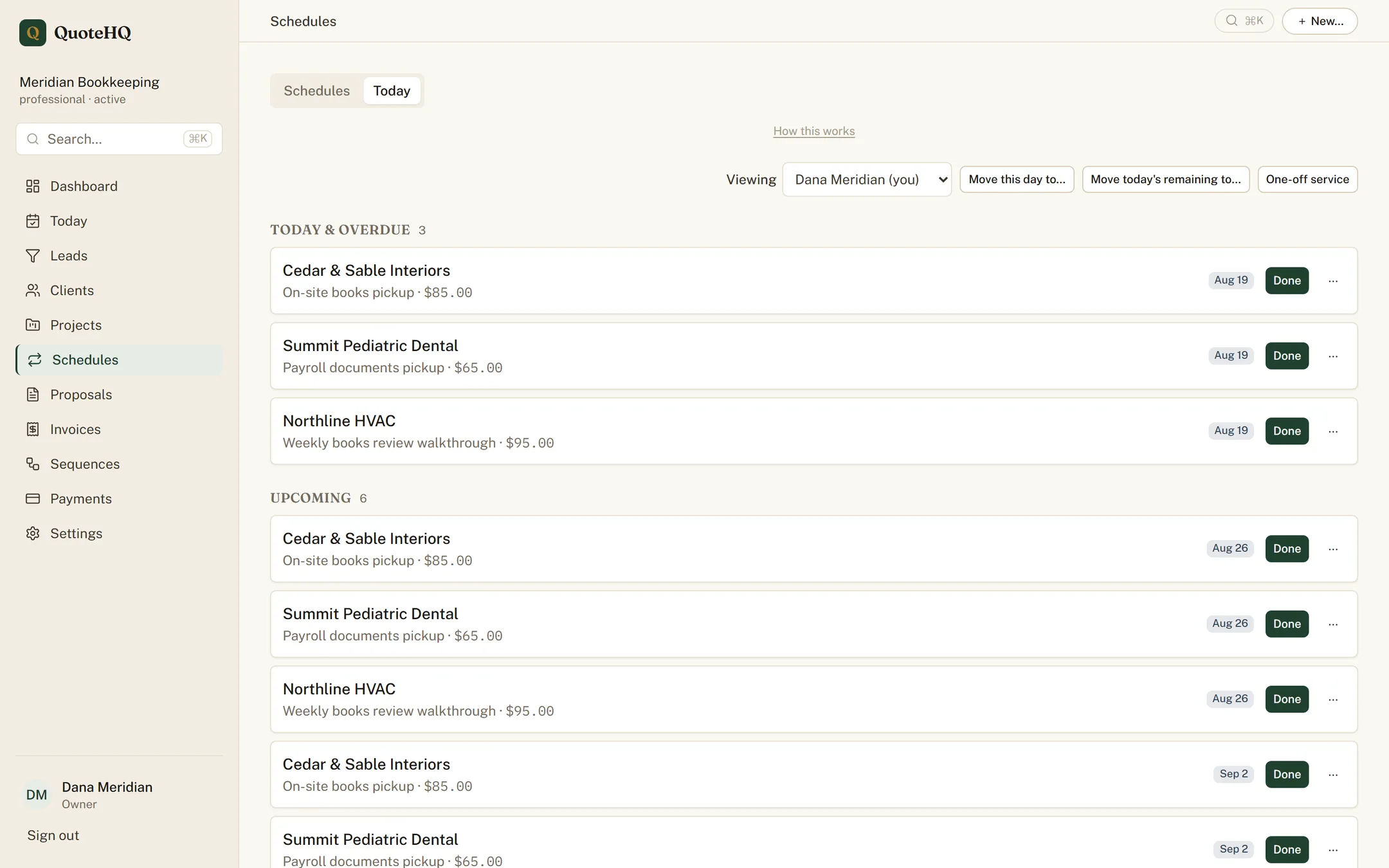
The fix is to make the visit the billable thing, not the period. In QuoteHQ, a weekly or biweekly schedule mints a visit each time the crew is actually due, and a skipped visit — rained out, customer cancelled — is simply a visit that never happened and never gets billed. The schedule doesn’t need managing around the weather; it already accounts for it.
It’s worth telling the customer this rule up front, before the first rained-out week ever happens. A customer who understands that their bill only ever reflects visits that actually occurred doesn’t call to ask why this month’s total looks lower than usual — they already know why, because you told them the rule before it mattered. The alternative, where a customer only learns the billing logic when they’re confused by an invoice, turns a non-event into a support call.
Several visits, one clean bill
Whatever cadence you invoice on — weekly, every two weeks, monthly — QuoteHQ groups the visits a property actually had into a single invoice, rather than a separate bill for every mow. A customer on a monthly bill sees one line per visit and one total, with nothing to match up by eye against a calendar in their head. The QuoteHQ for lawn care page walks through the whole loop from the first estimate to that consolidated bill.
One property, a rained-out month
- Week one
- mowed — billed
- Week two
- rained out — skipped, not billed
- Week three
- mowed — billed
- Week four
- mowed — billed
Two prices, no math for you to do
However you structure the season, you shouldn’t have to eat the cost of accepting a card, and you shouldn’t have to hand-calculate a surcharge either. Every invoice can offer two honest prices from the start: one for a card, one for a bank transfer. The customer sees both and picks the rail they’d rather use. You net the number you quoted the property, whichever one they choose. The full mechanics — and why it beats bolting a charge onto the total after the fact — are in dual pricing explained, and the invoicing side of it lives on the invoices & payments page.
A one-time cleanup isn’t a recurring visit
Don’t force a spring cleanup, a mulch job, or a storm-damage haul-away onto the same pricing logic as a standing mow. A one-time job is priced for the scope in front of you — quoted, signed, invoiced once — while a recurring visit is priced for a season of repeat work where consistency matters more than any single ticket. Mixing the two into one flat number either overcharges the one-time work or undercharges the recurring relationship. Keep them as separate line items even when they land on the same customer, so raising a seasonal add-on price never quietly drags the standing mow price along with it.
The same logic holds when a season changes. Raising your recurring price for next year is a conversation you have with a customer directly, on your terms, ahead of the first invoice at the new rate — not something that should ever get tangled up in what a one-off cleanup cost them last month.
Autopay, for the accounts that earn it
A standard package with a fixed monthly price is a good candidate for a card on file: the amount never surprises the customer, so charging it automatically on the due date is exactly what they signed up for. A property still on straight per-visit billing, where the total moves with what actually happened, is a worse fit — save autopay for the bill nobody has to double-check. Set the schedule once on the scheduling page and the billing follows the route, not the other way around.
Pricing a season is a business decision only you can make. What shouldn’t be a decision every single week is whether this month’s bill matches the work that actually got done. Get that part automatic, and the pricing structure you pick just works.
Quote it. Sign it. Get paid.
Start a free trial and run the whole loop — proposal, signature, deposit, books that write themselves — before the day is out.