Dual pricing explained, with the real math
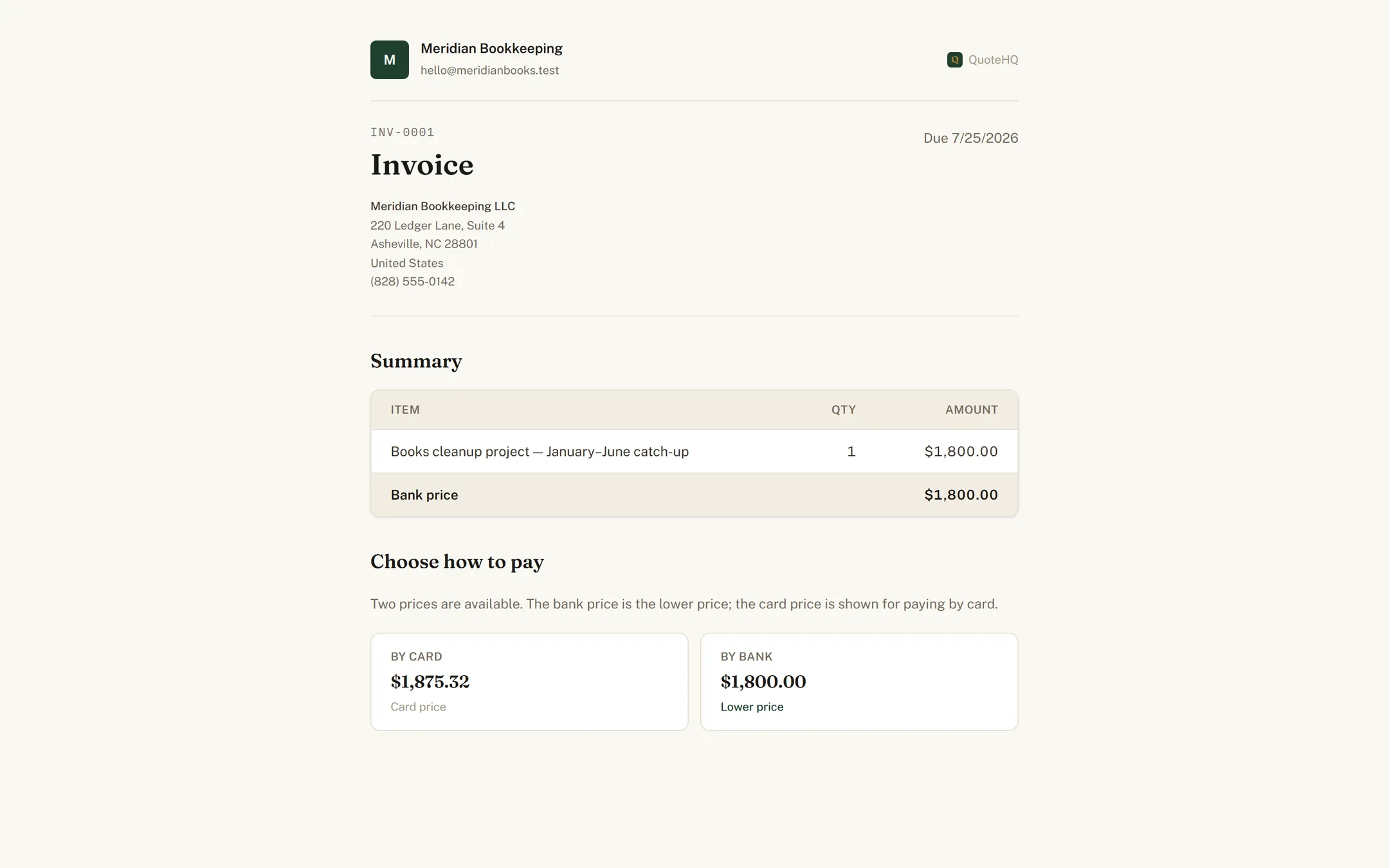
Card processors do not work for free. On every card transaction a processor takes a percentage of the amount plus a flat charge — for the rate QuoteHQ passes through, that is 4% plus $0.30 per charge. On a $1,800.00 deposit that is real money, and if you absorb it, it comes straight out of the number you quoted.
There are three ways to handle that cost. You can eat it. You can add it back naively. Or you can price the two rails correctly. Only the third one leaves you whole, and the difference is arithmetic, not opinion.
Eating the cost compounds
Absorb 4% plus $0.30 and it feels small on any one invoice. On our $1,800.00 deposit the cost is $75.32. Collect four deposits like that in a month and eat that cost on all of them, and you have handed the processor $301.28 that month — $3,615.36 across a year. That is not a rounding error. It is a line you could have kept.
Adding a naive surcharge doesn’t break even
The instinct is to add the cost back: take 4% of the base, add the $0.30, and bill that. On our example that is $1,872.30. It looks right. It isn’t — because the processor’s 4% now applies to the larger number you just charged, not to the base you started from.
Naive surcharge on a $1,800.00 deposit
- Base price you quoted
- $1,800.00
- Add 4% + $0.30 of the base
- $1,872.30
- Processor takes 4% + $0.30 of that
- −$75.19
- You actually net
- $1,797.11
You are short $2.89. Small, but it is short every single time, and it grows with the ticket. The cost has to be grossed up, not added on.
The correct gross-up
To net your full base after the processor takes its cut of the charged amount, you divide, you don’t multiply. The card price is the base plus the fixed charge, divided by one minus the rate:
card = ⌈ (base + $0.30) ÷ (1 − 4%) ⌉
On our deposit that is ($1,800.00 + $0.30) ÷ 0.96, rounded up — $1,875.32. Now when the processor takes 4% plus $0.30 of $1,875.32, what lands in your account is your full $1,800.00. The rounding always goes up, so you are never a cent short.
Dual pricing on a $1,800.00 deposit
- Base price (bank transfer / ACH)
- $1,800.00
- Card price the client sees
- $1,875.32
- Card-price difference, carried by the payer
- +$75.32
- You receive, either rail
- $1,800.00
Dual pricing is not a checkout surcharge
Worth being precise here, because the words get used loosely. A surcharge adds a charge to a card sale at the register — you ring up the base, then tack a card charge onto it. Dual pricing lists two prices from the start: a card price and a lower cash-or-bank price. The client sees both before they choose and picks the rail they prefer. Because the cost is built into a listed price rather than added after the fact, dual pricing is generally the cleaner posture under card-network rules. Rules vary and none of this is legal advice — but presenting two honest prices is a very different thing from bolting a charge on at the end.
The rail with no card cost at all
The other half of dual pricing is that a bank transfer (ACH) carries no card cost. On a big-ticket balance that matters: the client moves $1,800.00 from their account, it costs them nothing extra, and you receive $1,800.00. Card is for speed and convenience; bank transfer is for size. Listing both prices lets the client trade one against the other themselves.
In QuoteHQ this is automatic. Every invoice offers both rails, the card price is computed with the formula above and frozen when you send, and the client picks. You can read the full mechanics on invoices & payments, and if you write big-ticket quotes, QuoteHQ for contractors walks through a deposit on a five-figure job.
The whole idea is small and stubborn: the cost of taking a card should land on whoever chooses to pay by card, not on the number you worked out for the job. Price both rails honestly and it does.
Quote it. Sign it. Get paid.
Start a free trial and run the whole loop — proposal, signature, deposit, books that write themselves — before the day is out.