Proposal to paid: collect the deposit the day the client signs
The most expensive moment in a service business isn’t losing a bid. It’s the gap between “yes” and money. A client says go, and then a proposal sits in one tool, a signature waits in another, an invoice gets raised a few days later, and the deposit lands a week after the enthusiasm did. Deals cool in that gap. The fix is to make paying part of the signing moment, not a separate errand that happens afterward.
Here is the whole path in QuoteHQ, from a blank draft to a deposit in the account.
Draft the proposal — one-time work and recurring, split cleanly
You start by describing the job. QuoteHQ drafts the scope and the line items; you edit until it reads the way you’d have written it. Line items split two ways: one-time work (a setup fee, a deposit, a fixed project) and recurring work (a monthly retainer, a quarterly review). That split matters later — the one-time lines become the deposit invoice, and the recurring lines become a schedule that bills itself. You approve every line before anything goes out. The proposals feature covers the drafting in depth.
Publish and send a link
When the proposal is right, you publish it and send the client a link. No PDF attachment to download, no version to lose track of. The client opens a clean page with your branding, the scope, the prices, and — if you’ve set them — your terms. Everything they need to say yes is on one page.
The client reviews, accepts the terms, and signs
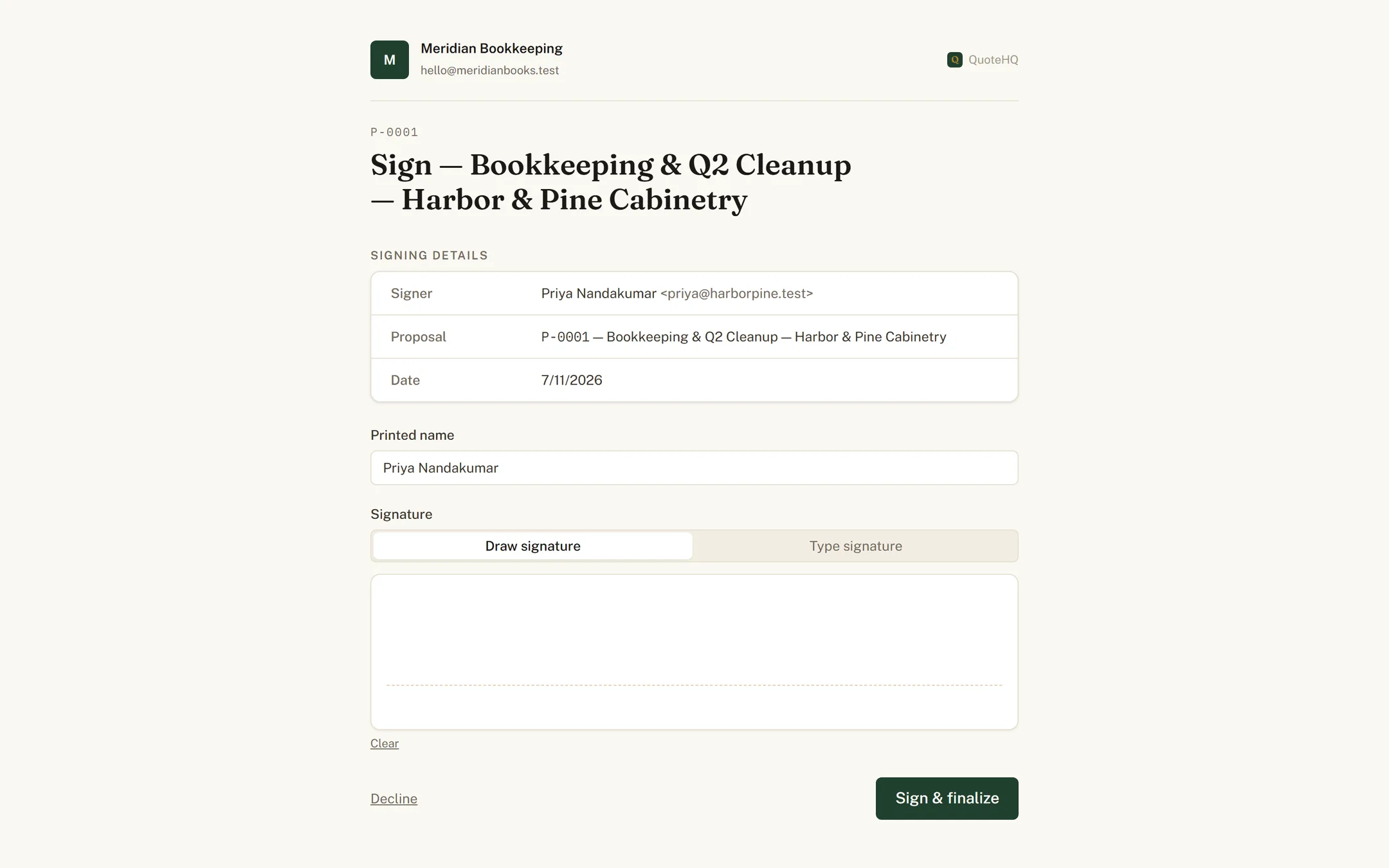
This is the part most tools make heavy and QuoteHQ keeps light. The client reads the proposal, accepts your terms and conditions, and signs in the browser. The signature is built to the U.S. ESIGN Act: QuoteHQ records their consent, name, IP address, browser, and a timestamp, and snapshots the exact terms they agreed to. Once signed, the document is sealed to a tamper-evident PDF fingerprinted with a SHA-256 hash and kept in a retained archive. When an agreement needs both names, a countersign line captures yours too. No printing, no scanning, no chasing a signature by email for a week.
What the signature carries
- Consent, name, IP, browser, timestamp
- recorded
- Terms & conditions as agreed
- snapshotted
- Sealed PDF, SHA-256 fingerprint
- archived
Acceptance fires the deposit invoice — automatically
This is the hinge. The moment the client signs, QuoteHQ raises the deposit invoice from the one-time lines on the proposal. You don’t re-key the amount, re-enter the client, or remember to do it later. The same numbers the client just agreed to become an invoice with a pay link, in the same sitting, while the yes is still warm. If the proposal had recurring lines, the schedule to bill them is set up at the same time.
They pay — card or bank — from the same page
The client is already on the screen, already decided. Now there’s a pay button. They pay by card or by bank transfer (ACH) without leaving. Dual pricing means the card cost sits with the payer who chooses card, so you net the deposit you quoted either way — the math is laid out in invoices & payments. The deposit clears, the invoice marks itself paid, and the deal is funded before the client has closed the tab.
The books post themselves
Behind all of this, if you’ve connected QuickBooks Online, the invoice posts as income, the payment clears against it, and any card-price difference books as its own expense — the moment money moves, categorized, without a second entry from you. By the time you think to check, the transaction is already in your books. That’s the QuickBooks sync doing the part you’d otherwise do by hand at month-end.
Why the sequence matters
Every handoff in that chain is a place a deal can stall: a proposal that needs re-sending, a signature that needs chasing, an invoice someone forgets to raise, a payment that waits on a mailed check. Collapse the chain into one sitting and the stalls disappear. The client signs, the invoice fires, the deposit is paid, the books update — before anyone’s enthusiasm has a chance to fade.
If your work is scope-heavy — statements of work, retainers, phased engagements — QuoteHQ for consultants shows the same flow with a signed SOW and a retainer that invoices itself. The principle holds whatever you sell: the day a client says yes is the day to collect. Don’t leave money sitting in the gap.
Quote it. Sign it. Get paid.
Start a free trial and run the whole loop — proposal, signature, deposit, books that write themselves — before the day is out.