Invoicing for cleaning businesses: several visits, one bill
A cleaning business runs on volume — a lot of small, recurring jobs, not a handful of big-ticket ones. That’s exactly the shape of business that a generic invoicing workflow handles worst. Built for occasional, large invoices, most tools make you choose between billing every visit separately (a flood of small invoices nobody wants to open) or tracking balances by hand in a spreadsheet until you remember to bill. Neither scales past a handful of standing accounts.
The problem with invoicing every visit
A weekly clean at a small office generates four visits a month. Bill each one separately and you’ve created four invoices, four due dates, and four chances for a client to lose track of what they owe. Multiply that across a real book of recurring accounts and you’re spending more time raising invoices than you spend cleaning. The fix isn’t billing less often on faith — it’s consolidating what already happened into one clean bill.
Group visits by cadence, not by job
QuoteHQ bills the visit as the underlying billable event, then groups the visits since the last invoice into a single bill on the cadence you choose — weekly, biweekly, or monthly. A client on a twice-weekly office clean gets one bill a month listing what happened and when, not eight separate ones. The crew keeps working the route; the invoice catches up behind them automatically. The QuoteHQ for cleaning page walks through the loop from the first inquiry to that consolidated bill.
One office account, one month
- Clean, week one
- completed
- Clean, week two
- completed
- Clean, week three
- completed
- Clean, week four
- completed
What actually belongs on the consolidated bill
A grouped invoice only builds trust if it’s legible — a client who sees “four visits, one total” with no detail underneath has no way to check the math, and a client who can’t check the math eventually stops trying to and just starts questioning every bill. Each visit stays its own line, with its own date, so the total is a sum a client can actually verify at a glance rather than a number they’re asked to trust. That’s true whether the account is a small residential clean or a larger commercial contract with a facilities manager who has to justify the spend upstream — the itemized visit list is what makes either one defensible without a phone call.
Commercial accounts add a wrinkle residential ones usually don’t: a facilities manager or property group often wants one bill across several locations, on a schedule their own accounts-payable process runs on — net-30, a specific day of the month, a particular format. Grouping by cadence rather than by individual job is what makes that possible; the underlying visits stay accurate to what happened at each site, while the bill itself matches the rhythm the client’s own books run on.
When a job needs a deposit — and when it doesn’t
A deposit workflow exists to protect a business from a customer walking away from a big-ticket job before it starts. That logic doesn’t hold for a standing recurring clean, where there’s no large upfront cost at risk in the first place, and forcing a deposit step onto a routine account just adds friction the relationship doesn’t need. Save the deposit for the job that actually warrants one: a large one-time move-out clean, a post-construction job, anything sized enough that walking away would hurt. Let the small, standing accounts bill straight through.
Autopay for the accounts that never need a conversation
A standing weekly or biweekly clean at a fixed price is close to the ideal autopay candidate: the amount never changes, so a card kept on file with the client’s consent can be charged automatically the day each consolidated bill comes due. Nobody has to remember to invoice, and nobody has to remember to pay. Reserve it for accounts where the total genuinely doesn’t move — a one-time deep clean with a variable scope still belongs on an ordinary invoice with a pay link, not a silent charge. The invoices & payments page covers both paths.
A standing account on autopay can still pick up a one-time add-on — a carpet clean tacked onto the regular visit, a one-off window job — without breaking the automation. The add-on rides its own invoice, priced and confirmed on its own terms, while the recurring clean keeps billing at its usual fixed amount on autopay. Folding a variable extra into the standing total would be the one move that turns a predictable charge into an unpredictable one, which is exactly the thing autopay isn’t supposed to do.
Every clean is a route, and every route is a schedule
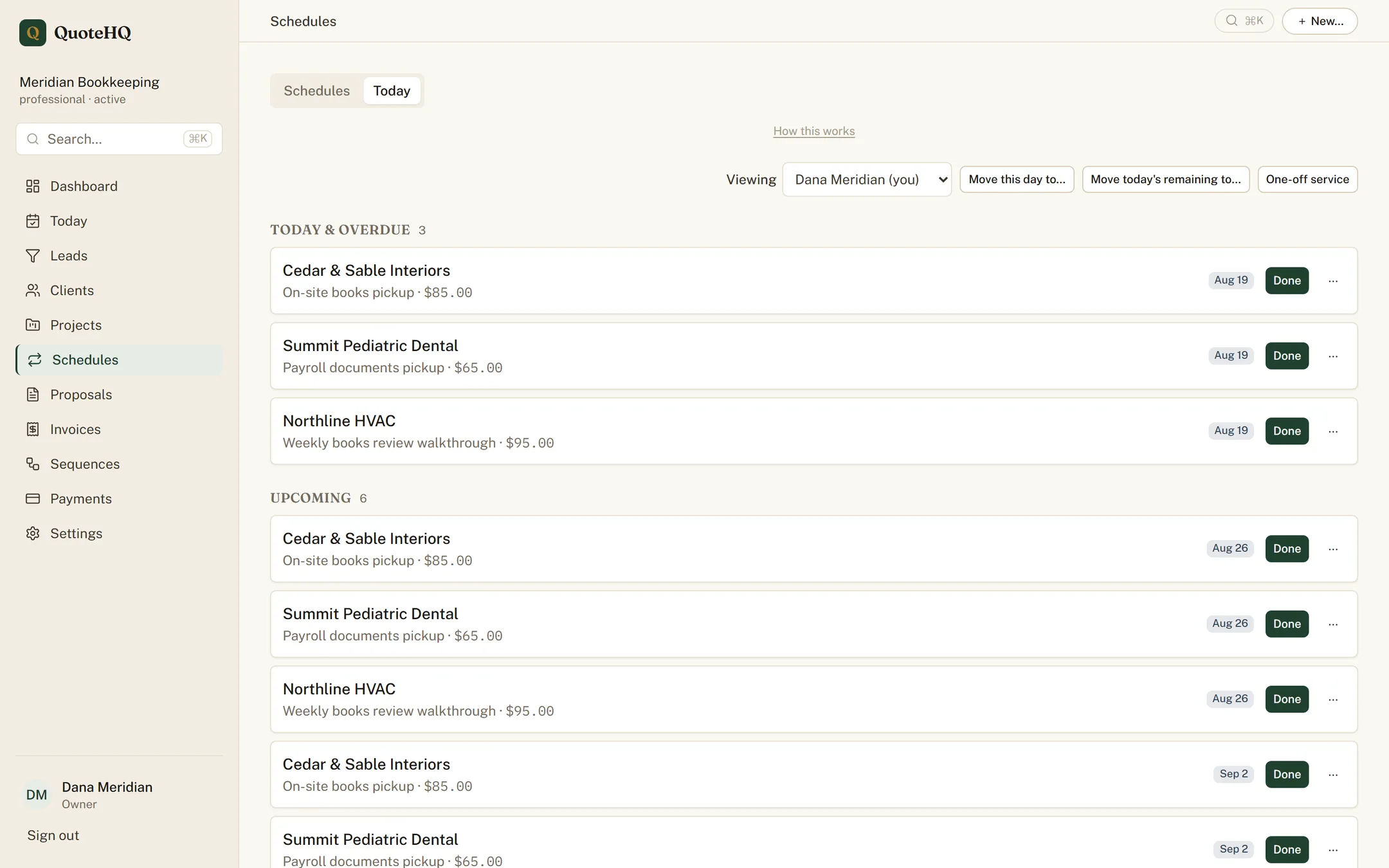
Consolidated billing only works if the schedule underneath it is trustworthy — a job that never got logged can’t be billed, and a job that got logged twice gets billed twice. Setting the cadence once on the scheduling page, with a day view each cleaner can check for their own stops, is what makes the invoice that comes out the other end match the work that actually happened. Running a mixed book of indoor and outdoor accounts? QuoteHQ for lawn care covers the same idea for a mowing route.
None of this is about billing less. It’s about billing the way the work actually happens — visit by visit, grouped into one honest total — instead of forcing a volume business through a workflow built for the occasional five-figure job.
Quote it. Sign it. Get paid.
Start a free trial and run the whole loop — proposal, signature, deposit, books that write themselves — before the day is out.