A bookkeeper's guide to autopay
Chasing the same three clients for the same fixed fee every month is a tax on your time that no engagement letter accounts for. Autopay is the answer for the right invoices — and a liability for the wrong ones. This is a working guide to which is which, and how QuoteHQ handles the mechanics so you stay in control.
What card-on-file autopay actually is
Autopay is a stored-credential payment: the client’s card is kept on file and charged automatically when a recurring invoice comes due. The word that matters is consent. A card is only stored with the client’s explicit written authorization, and QuoteHQ records that consent with a version and a timestamp — so if the authorization language changes, you can tell exactly which version each client agreed to. This is not a handshake. It is a recorded agreement to charge a card on a schedule, and it’s the foundation the rest of this rests on.
When autopay fits
Autopay belongs on invoices where the amount is known in advance and doesn’t move: a fixed monthly write-up fee, a flat retainer, a standard package. The client agreed to a number, the number is the same every period, and there are no surprises. For a fixed $350.00-a-month bookkeeping engagement, autopay is exactly right — the client consented to that amount, and charging it on the due date is precisely what they signed up for.
When it doesn’t
Autopay is wrong for variable bills. If the amount changes period to period — hours that vary, pass-through costs, usage — a silent charge for an unexpected number is how you earn a dispute and lose trust in one transaction. The rule of thumb: autopay a bill the client can predict to the cent, and email a bill they can’t. A surprise amount pulled from a card breeds chargebacks; a variable invoice with a pay link lets the client see the number before they pay it.
A quick sorting rule
- Fixed monthly write-up, flat retainer
- autopay
- Standard fixed package
- autopay
- Variable hours, pass-through costs
- email a pay link
How the flow works in QuoteHQ
There are two ways a card gets on file, and both run through the same consent gate.
The client can save their own card through a secure link you send — they enter it, they check the authorization, and it’s stored against their record. Or you enter the card yourself with an attestation that you have their authorization to do so. Either way, one card per client, and the consent is recorded with its version.
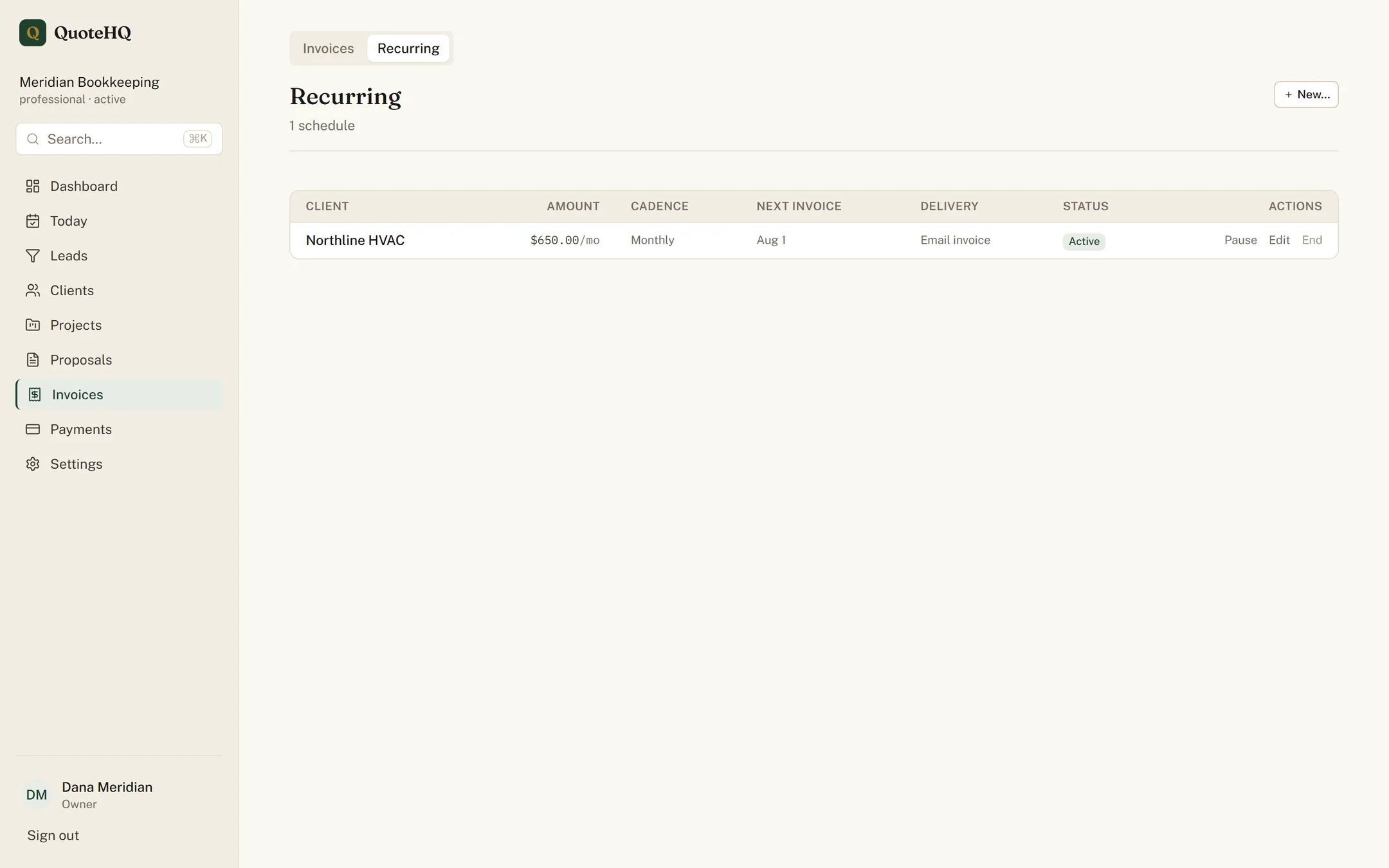
With a card on file, you set a recurring schedule — monthly, quarterly, semiannual, or annual — and enable autopay on it. When an invoice on that schedule comes due, QuoteHQ charges the stored card on the day. The client doesn’t lift a finger, and neither do you. The payments feature covers the recurring schedules in full.
What happens when a charge fails
This is the part to get right, because a failed charge handled badly is worse than no autopay at all. When an autopay charge fails — an expired card, a decline — QuoteHQ does not retry the card silently. It falls back to a normal invoice, emailed to the client with a pay link, exactly as if you’d billed them by hand. The client sees the amount, updates their card or pays another way, and the pay link stays live. No repeated hits on a dead card, no mounting decline fees, no mystery. A failure becomes an ordinary invoice, not an incident.
The bookkeeping payoff
Here is where autopay earns its keep for a bookkeeper. Every autopay charge posts to QuickBooks Online automatically: the invoice as income, the payment cleared against it, any card-price difference booked as its own expense — categorized, the moment the charge settles. You are not matching deposits to invoices by hand at month-end, because the entry you’d have made is already there. Collect a book of fixed monthly fees on autopay and the close for those clients is a glance, not an afternoon. The QuickBooks sync handles the posting; the bookkeeper’s workflow puts the whole billing-to-close line in one place.
Used with judgment — recorded consent, fixed amounts, a clean fallback when a card fails — autopay turns your most predictable revenue into your least demanding. That’s the whole point: the money you can count on should be the money you never have to chase.
Quote it. Sign it. Get paid.
Start a free trial and run the whole loop — proposal, signature, deposit, books that write themselves — before the day is out.